
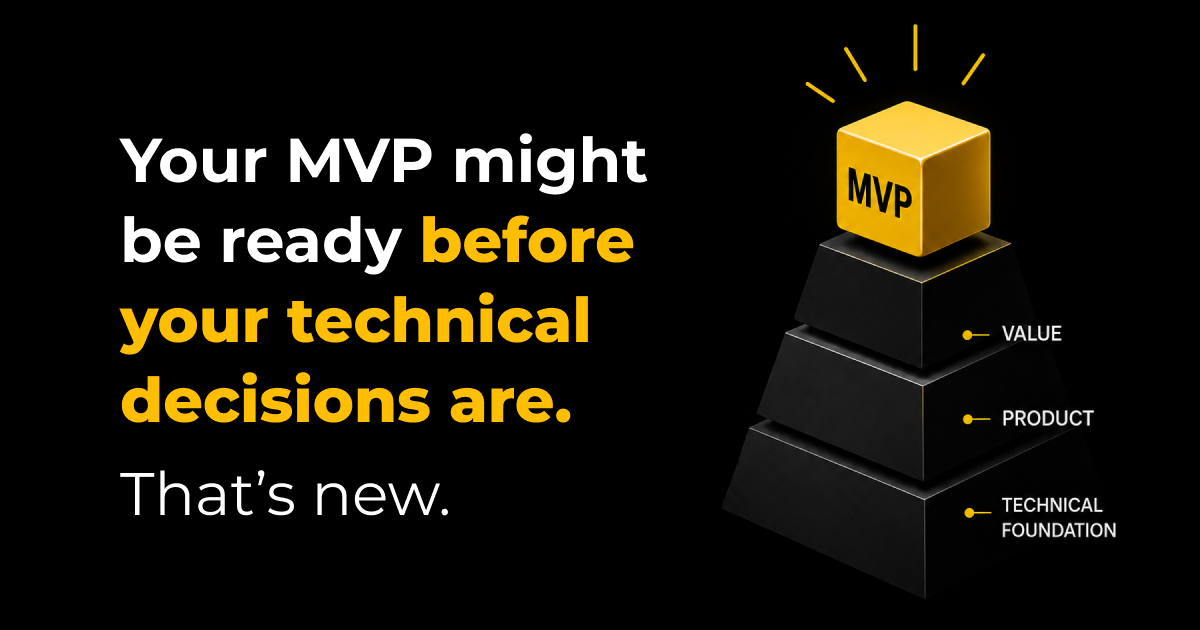
For a long time, the sequence of software product development was relatively predictable. Acompany had an idea. Technical decisions followed. Developers selected the architecture and tools,development started, and eventually an MVP appeared.
AI-assisted development is beginning to rearrange that sequence.
A founder can now arrive at something functional before there is an engineering team in place.Product behaviour can be explored before the architecture is settled. Early users can interact withfeatures while decisions about infrastructure, data models, security or long-term maintainability arestill unresolved.
This is not necessarily a problem. In many cases, it is an advantage.
Technical decisions have historically been made with incomplete information. Teams had to predictwhat users would want, which workflows would matter and how a product might evolve. Building wasexpensive enough that a considerable amount of thinking happened before anyone could interactwith the product.
When experimentation becomes cheaper, some of those assumptions can be tested first.
A founder can learn which feature users actually care about before designing a system around fivefeatures nobody wants. A team can test a workflow before committing significant engineeringresources to it. An MVP can increasingly become an input into technical planning rather than simplythe output of it.
But this creates a new transition point that product teams need to recognise.
The technical choices that helped create an experiment quickly are not automatically the technicalchoices that should support the product long term.
Once an MVP begins proving its value, the questions change. What data does the system hold? Whoshould have access to it? What happens when usage grows? Which parts of the currentimplementation are temporary? Where are the dependencies? How will the product be monitored,tested and deployed? Can another engineer understand and safely modify what has been created?
The mistake is not building before answering every one of these questions. Doing so can be exactlythe right strategy when the primary goal is learning.
The mistake is allowing an experimental implementation to become production infrastructure byaccident.That distinction matters because AI is making the boundary less visible. An MVP can look polished. Itcan have real users. It can even generate revenue. From the outside, it may already look like afinished software product while important technical decisions remain unresolved underneath.
This changes the role of the engineering team that enters after validation. Their job is not simply to"clean up the code." It is to understand what the MVP has already taught the business and translatethose lessons into deliberate technical choices.
That can mean keeping parts of the existing implementation, replacing others and resisting thetemptation to rebuild everything simply because the first version was created differently.
The emerging product-development sequence may therefore look less like idea, architecture,development, MVP - and more like idea, experiment, evidence, technical decisions, product.AI gives founders an opportunity to learn earlier. The companies that benefit most will be the onesthat also recognise when experimentation has done its job and deliberate engineering needs to begin.

